
More than astrophotography, an astronomical exploration.
The Western Veil
David Cruz · Astromidnight
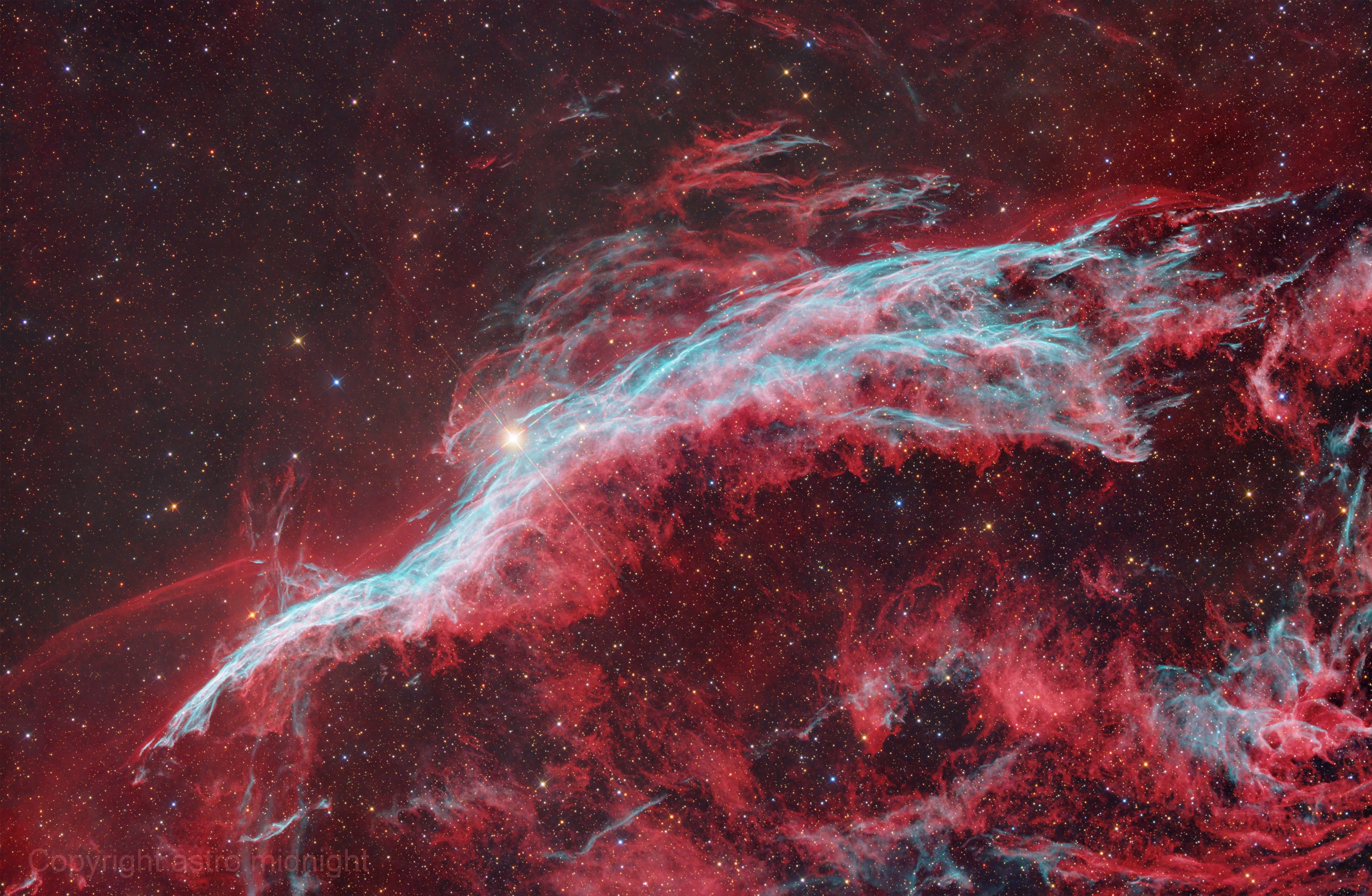
In Cygnus, the shock wave from a star that exploded thousands of years ago sweeps through the gas ahead of it and makes it glow. The red is hydrogen, the blue is oxygen.
| Catalogue | New General Catalogue, 1888 · NGC 6960 · LBN 191 |
| Type | Supernova remnant |
| Distance | ≈ 2,400 light-years |
| Field | 83.7′ × 54.7′ |
| Real width | ≈ 58 × 38 light-years |
| Scale | 0.81″ / pixel |
| Orientation | −130° · south-west up |
| RA (centre) | 20h 46m 13s |
| DEC (centre) | +30° 35′ 27″ |
| Constellation | Cygnus |
| Objects in field | NGC 6960 · Cygnus Loop · 52 Cyg · white dwarf · Mira |
Distance of the Cygnus Loop measured with Gaia parallaxes of stars inside and behind the remnant (725 pc, Fesen et al. 2021); NASA uses an older value, ≈ 2,100 light-years. The real width assumes 725 pc. The age of about 8,000 years is the one given by NASA. 52 Cyg, the white dwarf and the Mira are in the Milky Way, in front of or behind the nebula, with no connection to it. Positions of NGC 6960 and the Cygnus Loop taken from AstroBin labels, so they are approximate; those of the stars come from SIMBAD.
15 h 00 min of light
Each tick is one exposure. 195 in total, with the camera at −10 °C and gain 100. Calibrated with 30 darks, 30 flats and 30 bias. The Moon stayed below 80 % illumination throughout.
Carbon Newton 10' f/4
ZWO ASI2600MC Pro
Sky-Watcher CQ350 Pro
Askar M54 OAG · ZWO ASI120MM Mini
TS-Optics Maxfield .95X Coma Corrector
Player One Anti-Halo Pro Dual-Band Ha+OIII Filter 2"
Adobe Photoshop · Pleiades Astrophoto PixInsight · Stefan Berg Nighttime Imaging 'N' Astronomy (N.I.N.A. / NINA)
São Pedro da Gafanhoeira, Évora · 358 m
Bortle 3