
More than astrophotography, an astronomical exploration.
The Trifid Nebula
David Cruz · Astromidnight
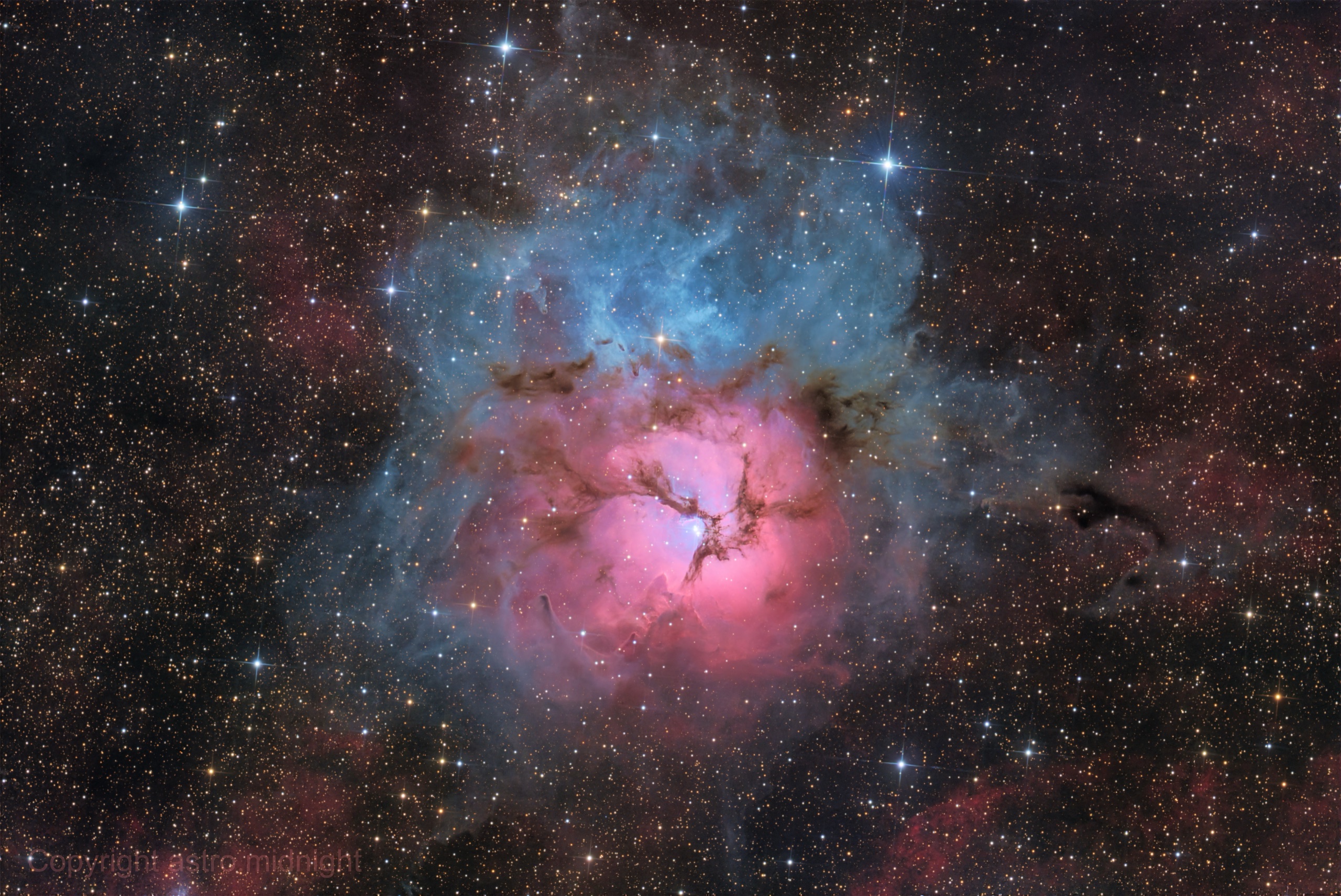
In Sagittarius, the Trifid Nebula brings together in a single cloud red hydrogen gas, blue reflection dust and three dark lanes. At the centre, a system of young, massive stars lights everything up with its radiation.
| Catalogue | Messier, 1764 · NGC 6514 · LBN 27 |
| Type | Emission and reflection nebula |
| Distance | ≈ 5,000 light-years |
| Field | 53.4′ × 35.7′ |
| Real width | ≈ 78 × 52 light-years |
| Scale | 0.34″ / pixel |
| Orientation | 4° · north up |
| RA (centre) | 18h 02m 29s |
| DEC (centre) | −22° 58′ 41″ |
| Constellation | Sagittarius |
| Objects in field | M20 · B85 · Sh2-30 · HH 399 |
Distance according to NASA (≈ 5,000 light-years). Estimates vary: the Gaia parallax of the cluster (Kuhn et al. 2019) gives about 4,100 light-years. The real width assumes 5,000 light-years. Positions of the nebulae taken from the AstroBin tags and therefore approximate; HH 399 placed using SIMBAD coordinates.
9 h 20 min of light
Each tick is a 240-second exposure. 140 in total, with the camera at −10 °C and gain 100. Calibrated with 30 darks, 30 flats and 30 bias. The Moon stayed below 60 % illumination throughout.
Carbon Newton 10' f/4
ZWO ASI2600MC Pro
Twinstar Friction Mount FG80
Askar M54 OAG · ZWO ASI120MM Mini
APM 2" coma correcting 1.5x Barlow (APM-Komakorr-Barlow2)
Adobe Photoshop · Pleiades Astrophoto PixInsight · Stefan Berg Nighttime Imaging 'N' Astronomy (N.I.N.A. / NINA)
São Pedro da Gafanhoeira, Évora · 358 m
Bortle 3