
More than astrophotography, an astronomical exploration.
Serpens Cloud
David Cruz · Astromidnight
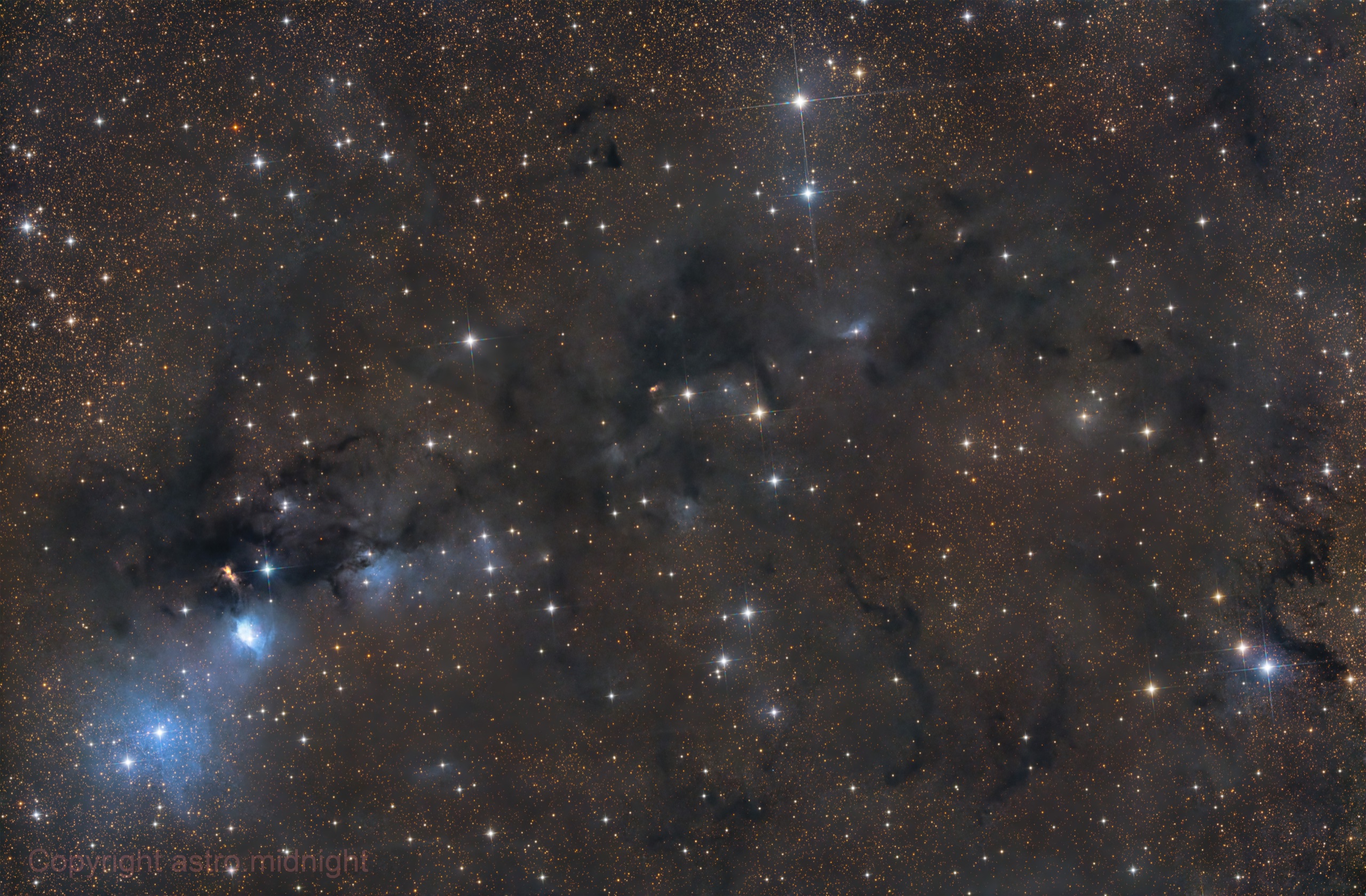
In Serpens, the Serpens dust cloud blots out the red stars of the Milky Way behind it. At its edges, young stars light up the dust in blue, as in vdB 123.
| Catalogue | van den Bergh, 1966 · HD 170634 |
| Type | Reflection and dark nebulae |
| Distance | ≈ 1,400 light-years |
| Field | 138.6′ × 90.9′ |
| Real width | ≈ 57 × 38 light-years |
| Scale | 1.35″ / pixel |
| Orientation | −96° · west up |
| RA (centre) | 18h 29m 28s |
| DEC (centre) | +00° 27′ 28″ |
| Constellation | Serpens |
| Objects in field | vdB 123 · Serpens Reflection Nebula · LBN 98 · 3 LDN · K 3-3 |
Distance of 436 ± 9 pc (≈ 1,400 light-years) measured by VLBA parallax for the Serpens/W40 complex (Ortiz-León et al. 2017). The real width assumes that distance; d Ser and HD 170795 are closer. Star distances from Gaia parallax (SIMBAD). Positions from SIMBAD; that of LBN 98 comes from the Lynds catalogue of bright nebulae, which only gives it to the minute of right ascension, so it is approximate, as are the centres of the LDN clouds.
13 h 20 min of light
Each tick is a 240-second exposure. 200 in total, with the camera at −10 °C and gain 100. Calibrated with 50 darks, 50 flats and 50 bias. The Moon stayed below 5 % illumination throughout.
TS-Optics 150mm/6" ONTC f/4 Newtonian (carbon tube)
ZWO ASI2600MC Pro
ZWO AM5
ZWO ASI120MM Mini
TS-Optics Maxfield .95X Coma Corrector · ZWO EAF
Adobe Photoshop · Pleiades Astrophoto PixInsight · ZWO ASIAIR
São Pedro da Gafanhoeira, Évora · 358 m
Bortle 3