
More than astrophotography, an astronomical exploration.
M101 in HOORGB
David Cruz · Astromidnight
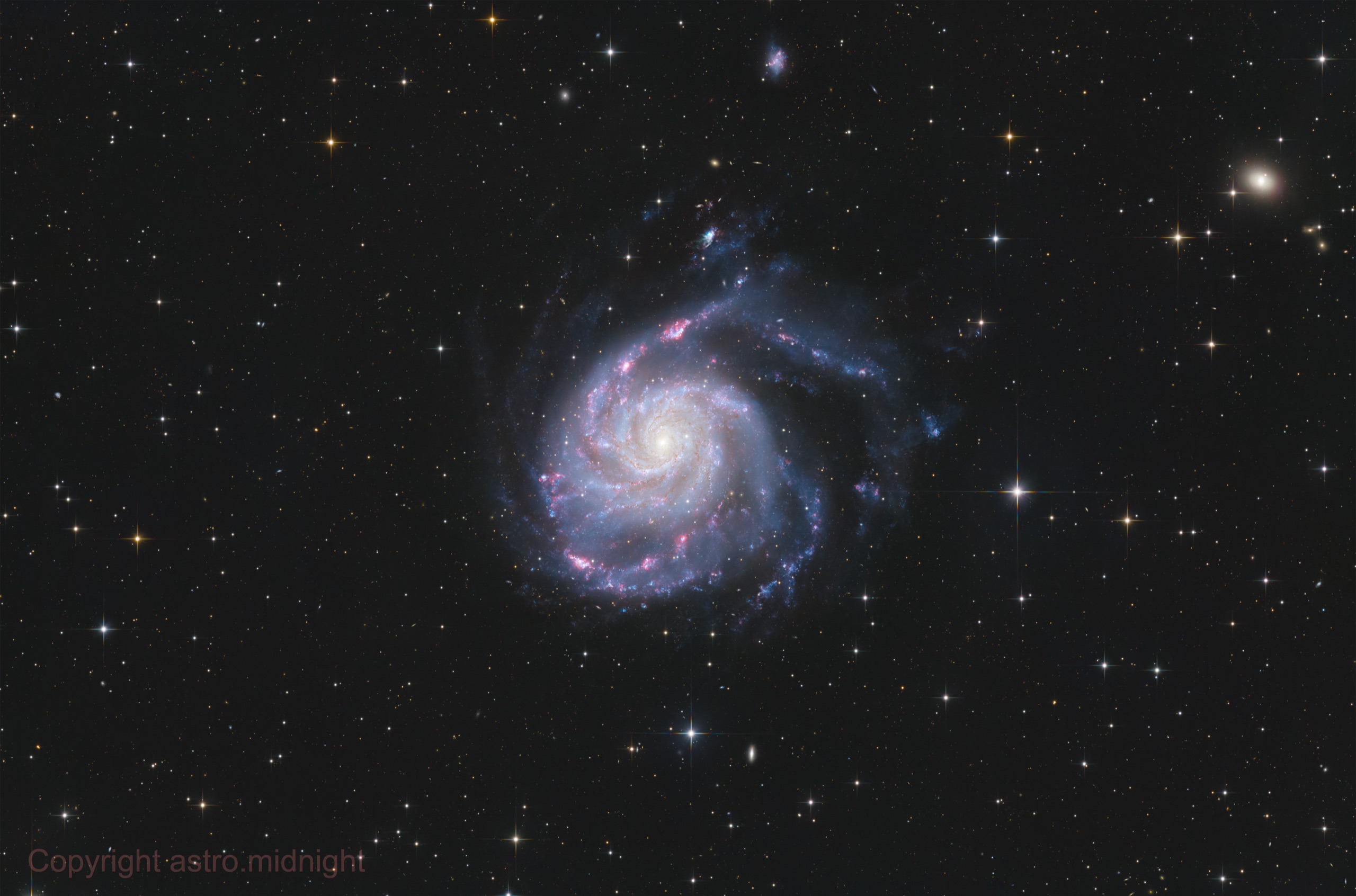
In Ursa Major, the Pinwheel Galaxy appears face-on, its arms dotted with pink clouds where stars are born. Its light travelled for about 21 million years to get here.
| Catalogue | Messier 101 · NGC 5457 · Méchain, 1781 |
| Type | Spiral galaxy |
| Distance | ≈ 21 million light-years |
| Field | 73.0′ × 48.3′ |
| Scale | 0.52″ / pixel |
| Orientation | 88° · east up |
| RA (centre) | 14h 03m 10s |
| DEC (centre) | +54° 21′ 44″ |
| Constellation | Ursa Major |
| Objects in field | M101 · 5 HII regions · 2 supernovae · NGC 5477 · NGC 5473 |
Distance of M101 according to APOD (2023) and Nugent et al. (2011, 6.4 Mpc); NASA/Hubble gives ≈ 25 million light-years, an older value. No real width: the field includes NGC 5473, a background galaxy about 4 times farther away, whose distance was estimated from redshift (NED, H0 = 70 km/s/Mpc). All positions come from SIMBAD coordinates, because several AstroBin labels were offset; those of the HII regions are approximate. The supernovae mark the site of the explosion and are not necessarily visible in this image.
17 h 00 min of light
Each tick is one exposure. 240 in total, with the camera at −10 °C and gain 100. Calibrated with 50 darks, 50 flats and 50 bias. The Moon stayed below 40 % illumination throughout.
Carbon Newton 10' f/4
ZWO ASI2600MC Pro
Sky-Watcher CQ350 Pro
Askar M54 OAG · ZWO ASI120MM Mini
TS-Optics NEWTON Coma Corrector 1.0x (TSGPU)
Player One Anti-Halo Pro Dual-Band Ha+OIII Filter 2"
Adobe Photoshop · Pleiades Astrophoto PixInsight · Stefan Berg Nighttime Imaging 'N' Astronomy (N.I.N.A. / NINA)
São Pedro da Gafanhoeira, Évora · 358 m
Bortle 3