
More than astrophotography, an astronomical exploration.
A Cosmic Storm in Sagittarius: IC 1284
David Cruz · Astromidnight
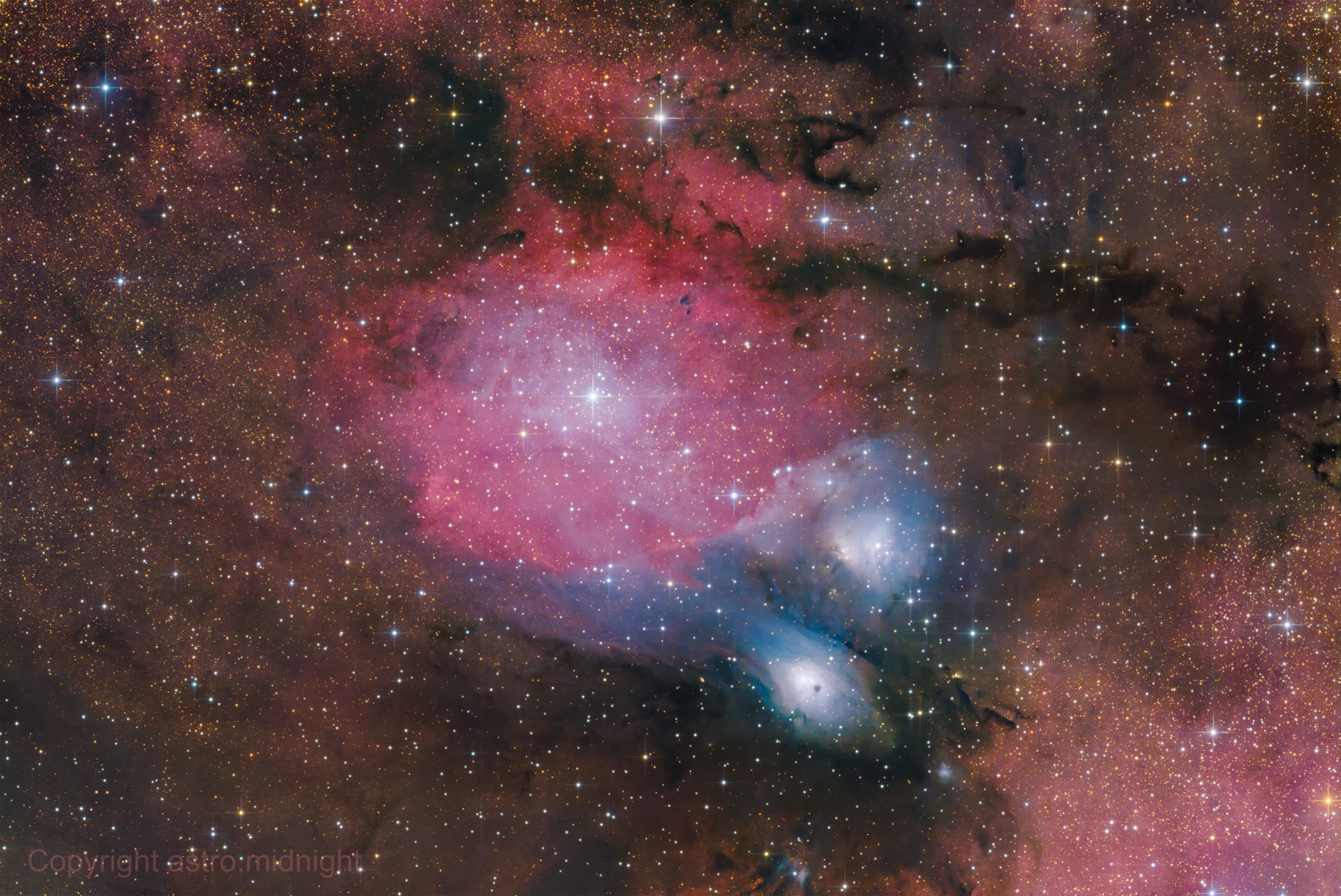
In the constellation of Sagittarius, towards the centre of the Milky Way, the hydrogen of IC 1284 glows pink and the dust in front of it blots out the stars. Beside it, two blue clouds reflect the light of the young stars born inside them.
| Catalogue | Index Catalogue, 1895 · Sh 2-37 |
| Type | Emission and reflection nebulae |
| Distance | ≈ 4,300 light-years (region) |
| Field | 53.4′ × 35.7′ |
| Real width | ≈ 66 × 44 light-years |
| Scale | 0.34″ / pixel |
| Orientation | −2° · north up |
| RA (centre) | 18h 17m 27s |
| DEC (centre) | −19° 42′ 31″ |
| Constellation | Sagittarius |
| Objects in field | IC 1283 and 1284 · NGC 6589 and 6590 · Dias 5 · V7995 Sgr |
Distance of the region from the Gaia parallax of HD 167638, the star that lights NGC 6589: 1,310 parsecs, the value adopted by Hillenbrand et al. (2026). HD 167722 and HD 313098, in the same complex, give almost the same (≈ 1,300 parsecs). IC 1284 has no published distance of its own and the popular catalogues repeat 5,500 to 5,900 light-years without a source; the real width assumes the 4,300. The position of NGC 6589 is that of HD 167638, because the SIMBAD entry points to an IRAS source 0.1° away. The catalogue position of IC 1283 is rounded to the hundredth of a degree, so the marker is approximate. Position of V7995 Sgr taken from Hillenbrand et al. (2026).
14 h 00 min of light
Each tick is a 240-second exposure. 210 in total, with the camera at −10 °C and gain 100. Calibrated with 30 darks, 30 flats and 30 bias. The Moon stayed below 45 % illumination throughout.
Carbon Newton 10' f/4
ZWO ASI2600MC Pro
Twinstar Friction Mount FG80
Askar M54 OAG · ZWO ASI120MM Mini
APM 2" coma correcting 1.5x Barlow (APM-Komakorr-Barlow2)
Adobe Photoshop · Pleiades Astrophoto PixInsight · Stefan Berg Nighttime Imaging 'N' Astronomy (N.I.N.A. / NINA)
Astromidnight Observatory, Alentejo - Portugal
Bortle 3